Showing posts with label Weekly Writing. Show all posts

Sunday, November 22, 2015

Classroom Management


Oh joy. Something that certainly most (if not all) teachers and student teacher worry about, classroom management. Now, there are many techniques used in the classroom for teachers to achieve smooth sailing throughout the school year.

I found this article of 21 Tips and Tricks in Classroom Management that I feel everyone who is planning on teaching should know. It helps with defining the techniques to use when a student gets their assignments done early to modeling desired behavior.

Whenever I started my 4-H club, I wanted my members to view me as the instructor and someone they feel comfortable enough to talk to with their projects. I constantly strive to build up confidence and engagement in my members at each and every meeting. Certainly, it can be tough whenever the kids are a little rowdy and wound up on snacks and sugar, but I manage to pull them back together.

Overall, we need to learn that we will get the hang of the classroom with time. It will not happen right away, but it will certainly happen.

Tuesday, November 3, 2015

Inquiry-based Learning

Last week I had the opportunity to attend the National FFA Convention (which you will be hearing more about in an upcoming post, I promise) where it was recommended to attend a teacher workshop if we were able. I was lucky enough to attend one of those workshops with my cooperating teacher, Mr. Campbell,  and we learned a lot.

The topic: The Livestock Dating Game

This was an inquiry-based lesson demonstrated by three Ag teachers from across the United States, and it taught me what Inquiry-based lessons and learning really was.

Let me tell you how it went...

The instructors asked for three male volunteers and one female volunteer to head to the front of the room. The interest approach was basically a bachelorette heifer looking for her soulmate in one of the three bulls. Each of the bulls read their descriptions and the entire class had the chance to vote for their pick of the herd.

Once that was completed, the presenters handed out some geography books and some laminated cards. We proceeded on with our activity by basically choosing which two breeds of cattle to cross that would fit the needs of a country in which each of our pairs were assigned.

We researched our country and choose a cross between a Florida Cracker and a Brahman, and the presenters went around the room to pass out results cards. These cards were random, so the results varied among each of the pairs. When that was completed, we discussed our results and were able to develop further questions from the activity.

So, what is Inquiry-based learning?

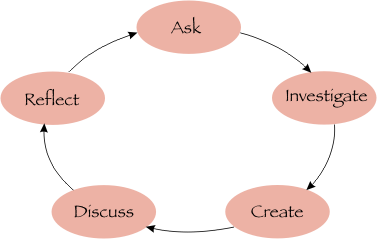
It is basically a learning process where the students are in control. The manage what they investigate, what questions to form, etc. The teacher ends up playing the role as the facilitator as they spend less time in lecture form and more time in the actually learning activity,

According to our reading, Inquiry-based learning is very beneficial for students and helps improve student success. It is obvious to see as they are actually applying their knowledge and digging deeper into the content.

In an additional article that I found (click here for article), it explains that there are definitely benefits for Inquiry-based learning. It helps in improving their science, research, and literacy skills, but there was not a significant difference between Inquiry-based and traditional curricula.

What are my Thoughts?

I really enjoyed that Inquiry-based workshop at the National FFA Convention, so I highly recommend using this tool in the classroom. Students have the ability to apply the knowledge learned from the activities to outside of the classroom, and they feel in control of their activity. Teachers can definitely take this and mold it into any shape they want and run with it!

Friday, October 9, 2015

Working Towards the Future

Students will often wonder to themselves how they are going to use their schoolwork outside of the classroom later on in life. It is much easier to apply activities to the "real-world" in the Agricultural Education through activities ranging anywhere from greenhouse work to tearing apart a small gas engine.

Incorporating problem solving into our curriculum will help students in developing many needed skills that will benefit them after the bell rings. Problem solving can be used as a group or individual project, and our students can be as creative as they want.

According to one of the articles that we read, "Principles for Teaching Problem Solving" explained that there are many students who struggle and fail in literacy in their own school programs. Using problem solving techniques in the classroom will help benefit our students as it will affect them outside of school. The article stated that grown adults tend to struggle with basic skills such as determining the correct amount of change from an information menu.

It is sad that we have grown adults struggling in simple skills that they need to survive the"real-world". If they were only given the necessary tools, and proper teaching techniques through problem solving, they would have no problem counting the change out of a register.

So what did I get out of our readings? Use a variety of different problem solving techniques that requires the students to think through multiple ways of how these problems can be solved.

Here is an article that I feel really explain what problem solving is, and how it works for the students and the teachers.